Thursday, August 19, 2010

World Humanitarian Day

As we celebrate the second annual World Humanitarian Day, our attention at Project HOPE naturally turns to the many volunteers and staff who have made relief efforts possible in places such as Haiti.

When the earthquake struck Haiti, doctors and nurses put aside their hospital duties, their private practices, their family vacations, to respond to this acute crisis.

The brief spotlight that shined on Haiti in the weeks after the tragedy exposed immense critical need, but it also reminded us of the country’s chronic, more “quiet” condition. If January 12th was the date that sent the country to the emergency room, then now is the time when Haiti’s caregivers must decide how to treat the chronic secondary condition diagnosed in the process.

This condition is seen in the thousands of amputees now in need of rehabilitation, as well as the widespread tuberculosis prevalent in the mountain regions and HIV in the valley populations, and in the young women dying in childbirth for lack of medical care.

The situation is serious. The very pipeline of future Haitian doctors and nurses is in peril. Hundreds of nursing students lost their lives when the nursing school, on the grounds of the country’s only public teaching hospital, collapsed. The nearby medical school was also largely reduced to rubble. And the hospital itself, which long served as the “safety net” hospital for the poor of Port-au-Prince, is now operating at less than 50 percent capacity, with many of its major facilities closed.

The prescription?

It will not be found in the well intentioned but "stand alone" efforts. Carlene Dei, USAID country director for Haiti, estimates that there are over 9,000 NGOs now working in the country, 80 percent of which are not collaborating with the U.S. Embassy and other NGOs. There must be a “whole community” effort if there is to be progress.

The effort must involve Haitian doctors, nurses and other health care workers. Hôpital Albert Schweitzer in Deschappelles, Haiti, embraces the philosophy of increasing and expanding local capacity and has become one of the two leading centers for trauma-related surgical amputations and subsequent rehabilitation in Haiti—a shining example for the rest of the country to follow. To continue to be able to move forward in this way, the pipeline of future doctors and nurses must be repaired.

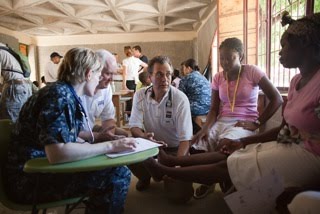
Just recently, I witnessed an outstanding response to the current "quiet crisis," now happening in Haiti. I saw the sailors of the USS Iwo Jima and volunteer doctors and nurses from non-governmental organizations, including Project HOPE, working side-by-side with their Haitian counterparts, engaged in treating those in medical need in Port-au-Paix, a city on the country's north coast.

It was a model of the "whole of community" approach to care that the ship's Commodore, Captain Tom Negus likened to the process of weaving a tapestry—integrating professionals from an array of specialties with the local needs of the patients.

All of these individuals, as well as those working behind the scene, making a difference in the lives of those in need, deserve our heartfelt salute on this day.


Photos by Project HOPE PAOs Astrid Riecken, Allison Shelley, and Eric Campbell

Tuesday, August 3, 2010

Haitian Doctors and Nurses: The Next Generation

In late May, Dr. Louis Sullivan, former Secretary of the U.S. Department of Health and Human Services and current Project HOPE Board member, and Dr. Ruben Pamies, Dean for Graduate Studies at the University of Nebraska Medical Center, asked to meet with me in Washington. They expressed a deep concern for the next generation of Haitian physicians and nurses, in light of the damage suffered by the medical and nursing schools in Port-au-Prince.

They asked Project HOPE to join in assessing the current capacity of Haiti’s health professions education – in the context of the future need for health care in the country. Two days ago, we visited the medical school, Universite D'Etat D'Haiti, which has been largely reduced to rubble. Today, we went to the site of a former nursing school on the grounds of the teaching hospital, Hopital Universite D'Etat D'Haiti, also known as General Hospital. What we saw was breathtaking. The nursing school building had been leveled – now replaced by UNICEF tents. Hundreds of nursing students lost their lives, when the school collapsed.

General Hospital, which long served as the “safety net” hospital for the poor of Port-au-Prince, is a shadow of its former self. What was once an 800-bed facility was reduced to a 300-bed capacity. Major buildings (general surgery clinic, inpatient women’s internal medicine, outpatient clinics and pediatrics) are shuttered. In the face of this, the need for urgent care continues on.

Nick Lobel-Weiss, Executive Director of Global Emergency Relief based in New York City, and secunded to the General Hospital, gave a most compelling example. A twenty-nine year-old woman with active tuberculosis, now in her 29th week of pregnancy, was in the midst of being transferred from the teaching hospital to the Adventist Hospital in the Diquini neighborhood of Port-au-Prince, which had been spared from major earthquake damage.

We met Dr. Megan Coffee, an infectious disease fellow from the University of California, San Francisco. She arrived in Port-au-Prince in late January -- and has been involved in round-the-clock care of critically ill patients since then. She told us of the high prevalence of post-partum, dilated myocardiopathy, not often seen in the U.S. These patients can present with an admitting diagnosis of tuberculosis when, in fact, their chest X-ray findings are those of heart failure. Here at General Hospital, earlier today, a 22-year-old woman was found sitting bolt upright gasping for air, due to this underlying heart problem.

Later in our visit, the director of pharmacy shared her gratitude for the medicines and medical supplies, donated by HOPE. She cited IV fluids from B. Braun and lidocaine from Hospira. We were later joined by two of the Haitian biomedical engineers who helped prepare HOPE’s assessment of medical equipment, requested by the Minister of Health after the earthquake, at six of the largest hospitals in Port-au-Prince.

Dr. Sullivan and Pamies are right – health professions education is at risk here in Haiti. Its future supply of physicians and nurses, and hence the future of country’s health care, is in question. While the focus of recent months has been on the acute crisis (post-earthquake trauma) and more recently, the quiet crisis (tuberculosis and diabetes), the unseen crisis (health professions education) is now at hand. The right prescription for returning Haiti to an adequate supply of physicians and nurses needs to be written as soon as possible. The health of Haitians, now and in the future, will be the beneficiary.

Monday, August 2, 2010

HOPE's Legacy Lives On

On the USNS Iwo Jima, three miles off the white sand coast of Port-au-Paix in northern Haiti, the berths are filled with doctors and nurses, engineers and electricians from the U.S. and countries around the world, now engaged in the Navy mission Continuing Promise.

Its mission—to train U.S. personnel, military and civilian, for humanitarian assistance and disaster relief—is the twentieth for Project HOPE and the Navy. What began with the tsunami, and 210 Project HOPE medical staff on the USNS Mercy, continues to this day aboard the Iwo Jima, where four separate Project HOPE rotations of volunteer doctors and nurses will be involved in its entire four-month deployment in Latin America.

The waters of the Caribbean are too deep for the ship to drop anchor at its current location, so it slowly moves in a square pattern at two knots – an appropriate metaphor for its always-in-motion schedule, one which will include eight countries, with visits of about ten days each.

Mission Commander, Captain Tom Negus, told us that this is the best experience of his Navy career, as he brings together people to deal with the most challenging of issues facing the region. Negus likened the process to weaving a tapestry—integrating professionals from a wide array of disciplines with the needs of the community.

From 5:00am to 7:00pm, seven days a week, the men and women of the Iwo Jima, including volunteers from HOPE and those of other non-governmental organizations, are reaching out to Haitians in need -- on the ship and on shore. These settings include clinics offering medicine and surgery, as well as operating rooms for eye and general surgery. Each day, over 600 men, women and children are the beneficiaries.

Earlier today, HOPE volunteer and internist Mike Polifka, now in his seventh Navy/HOPE rotation, cared for a young woman with swelling in her right leg. In the U.S., this finding might have been confused with venous insufficiency, swelling related to inadequate return of blood to the heart. Not so in Haiti, thanks to Dr. Polifka. He made the diagnosis of elephantiasis (filariasis) -- an infection involving the lymphatic system rarely seen in the U.S. The antibiotics that he prescribed will improve her life dramatically.

Port-au-Paix Mayor Charles Guillet Salvador came to the clinic this afternoon -- to personally thank Dr. Polifka and his Navy and HOPE colleagues. He spoke, in grateful terms, of the profound impact that the Iwo Jima is having on the people of Port-au-Paix. When the ship leaves in a week, they will have a different view, positive at that, of America.

All of this is in perfect keeping with the proud traditions of the first ship on which HOPE volunteers served: namely, the Consolation, a Navy hospital ship, painted white and renamed the SS HOPE in 1960. Its legacy lives on, here in Haiti, on the Iwo Jima.

Sunday, August 1, 2010

Intersection of Interests

For many weeks after the January 12th earthquake, the daily sound of chopper blades filled the quiet town of Milot, Haiti, as a 40-bed hospital swelled to serve 600 patients during helicopter airlifts to the Hopital Sacre Couer.

Sacre Couer has served the community of Milot, with a population of 35,000, since 1977, with additional referrals coming from Cap Haitian, the second largest city in Haiti. The hospital--whose specialty services, from complicated deliveries to neurosurgery, are renowned--has earned its place in history for its response to the first major earthquake to hit the country in many generations. And Project HOPE was at the heart of this effort.

Many of the earthquake-affected patients were transferred from the USNS Comfort where rotations of HOPE volunteer doctors and nurses were hard at work. They were admitted to the hospital where they benefited from the best of HOPE’s corporate partnerships.

For example, in the neonatal unit, dehydrated infants received Hospira fluids. In the intensive care unit, the sickest of patients were monitored by Siemens equipment. In the operating room, patients underwent surgery with the latest in cardiac monitoring from Philips. And throughout the hospital complex, patients and staff alike enjoyed clean water made possible by a solar-powered purification system from DynGlobal.

As I have mentioned in recent postings, I believe that in the direst of tragedies, the best outcomes are those made possible by not one but many heroes. In Haiti, these heroes were on the Comfort with its Navy and Project HOPE doctors and nurses, among the U.S. Marines making around the clock airlifts, within the staff at Sacre Couer, and found in the generosity of U.S.-based health care corporations. Each of these heroes joined HOPE in putting a face on America’s humanity.

Saturday, July 31, 2010

Shared Beginnings

As I look around at the lush, green mountains that surround the Hôpital Albert Schweitzer in Deschappelles, Haiti, I can’t help but be reminded of a similar pastoral setting many thousands of miles away— the Project HOPE headquarters in Millwood, Virginia. A country apart, the hospital and HOPE share in an often-intertwined vision of humanitarian aid and health education.

That the two organizations have led such parallel lives throughout the years is not a coincidence. Indeed, they were founded within two years of each other: Hôpital Albert Schweitzer (HAS) in 1956 by Dr. and Mrs. Lawrence Mellon, while Project HOPE was founded in 1958. A generous donation in 1977 by Rachel “Bunny” Mellon helped make possible the Project HOPE headquarters at Carter Hall, her childhood home in Virginia.

Fast forward to 2010. After the January 12th earthquake, HAS became one of the two leading centers for trauma-related surgical amputations and subsequent rehabilitation-- thanks to the generosity of the Hanger corporation (whose headquarters in Bethesda, Maryland is just steps away from our Health Affairs Journal offices).

In keeping with our shared mission, HOPE contributed to the hospital’s response to the earthquake. Currently, HOPE volunteer nurse, Jill Caporiccio of the Massachusetts General Hospital, is coordinating activities at the Hanger Clinic. With HOPE’s participation, the clinic has fitted over 400 Haitians, young and old, with prostheses, allowing them to return to normal lives.

Meanwhile, Haitian-American Certified Nurse Midwife and Project HOPE volunteer Carine Richard has been busily building the hospital’s midwifery program at its local dispensaries scattered throughout its 600 square mile service area.

Ian Rawson (stepson of Dr. Mellon), who now heads the hospital, shared an observation about Haiti today during an afternoon visit with patients. And it is one that I found very compelling. He observed, “Haiti is always in chronic crisis-- whether it be malnutrition or tuberculosis. Sometimes it is in acute crisis as well, from earthquakes to flooding. In the face of tragedy, the Haitian people are not rigid. They bend like bamboo, coming back with the best of resilience.”

His perspective has great relevance to HOPE. Where there is crisis there is HOPE. For us, the crisis may be acute, quiet or unseen. As our recent experience with HAS demonstrated, we are able to respond quickly to make a difference to those in need, no matter the crisis.

Friday, July 30, 2010

Inspiring Action in Haiti

Port au Prince, Haiti
Here in Haiti, at the frontline of a quiet crisis, we continue to meet leaders, young and old, who bring creativity and influence to the common good -- at the least, providing inspiration and at the most, inspiring action to move the country forward.

Inspiration. I suppose this could be one of the most cliché concepts to be covered in this kind of blog. Yet, for sure, it was the recurring theme of our day today.

It was seen in Carlene Dei, USAID country director for Haiti: a leader of noted academic and professional stature, who kept her appointment with Project HOPE -- in a most memorable way. She held the meeting with us in our sweltering SUV, when a security issue left us unable to enter the U.S. Embassy building. After a distinguished career with USAID, Dei was eligible to retire. Yet, she chose to continue to lend her expertise, gained in her native country of Jamaica and in Ghana, to her role as country director for Haiti. She is now leads a severely understaffed staff, with the wisdom of an experienced leader.

Additional inspiration came in the form of a chance encounter, as I picked my way through the graffiti-covered rubble of the nation’s only public medical school, with two young men on their way to class. The pair, fourth and fifth year students from Cap Haitian, are among 600 students at the school, one which regularly receives over 5,000 applications each year. While taking a break from a community health exam, they talked about their hopes and aspirations. I couldn’t help but marvel at them. Even in the most supportive of settings, medical education is nothing if not a daunting pursuit. But, here in a setting of utter destruction?

Finally, no sooner had our team been told that volunteerism is not often seen among the poor of Haiti (their days understandably involved in the very pursuit of survival), we witnessed an unforgettable sight. As we approached the Adventist Hospital of Haiti, we saw a line of young men and women bearing shovels, wearing familiar bright blue Project HOPE t-shirts. They were removing trash and rubble from the Hospital grounds -- as volunteers. This was yet another example of how HOPE inspires volunteerism -- and provides the setting to make it possible.

I continue to be reminded, here in Haiti, that the immensity of its tragedy does not lend itself to single heroes. Instead, it calls upon many individuals, many heroes humbly going about making a difference in the lives of those in need. I hope that you will be equally inspired.

Thursday, July 29, 2010

Where There is Crisis, There is HOPE

Port au Prince, Haiti July 28
As sleep lifted me from my fog this morning and the aircraft carrying our team descended into Port au Prince, browns and blues formed into the solid shapes of crumbled buildings and tarp-dotted tent camps. And somehow it all seemed so familiar-- a true physical manifestation of the countless news story images and my own imagination filling in the blanks.

But my first day in the battered Haitian capital still proved to have lessons in store. What I have seen in my brief tour so far has shown me that the Haitian people survive on sheer determination. They have walked through fire and come away with an inspirational sense of hope.

We saw the best of humanity in the faces of Theodore Clermelie and her 10-month-old son Joseph Salomon, who waited patiently all day on a crowded outdoor patio at Clinique Sainte Marguerite in the Delmas 75 neighborhood of Port au Prince for a treatment for the boy’s itchy-looking skin rash, a surprise allergic reaction.

Our backgrounds and languages were different, yet the tenderness with which Theodore engaged her son— bouncing him on her knee and using the bright red liquid in a bottle of Project HOPE-donated PediaLyte as an ad hoc toy—was universal.

Never in conversations did we hear talk about the recent traumatic events of the past. There was no looking over shoulders. From a vantage point six months from the date of the earthquake I suppose that I expected more of a focus on personal losses. Instead we saw eagle eyes trained on the future: Haitians engaging the world community in the common quest for bettering the country.

Without exception, the Haitian Ministry of Health has also stepped up to the plate with a daunting request of Project HOPE: to assess the biomedical equipment of Port au Prince’s six largest hospitals (which together possess 60% of the medical equipment in all of Haiti). This month-long project proved to be an intensely productive collaborative experience for the Project HOPE team of four volunteer American biomedical engineers and four of their Haitian counterparts—which assessed and catalogued 931 items.

As Project HOPE now moves into the second phase of this project, the training of Haitian technicians to use and maintain these machines, we are proud to be part of the unglamorous side of the job—making sure that things work for the people that need them.

Today, like many days, I see that where there is crisis, there is HOPE. And I can’t help but categorize what our team has seen into two distinct categories: acute crisis, such as was seen in Haiti immediately after the January quake, and quiet crisis, which can arguably represent what the country is experiencing now—with the focus shifting to the treatment of chronic illness and rehabilitation.

I am firmly reminded that as Haiti transitions from acute crisis to quiet crisis, Project HOPE continues to have relevance and importance for the people that it serves.